
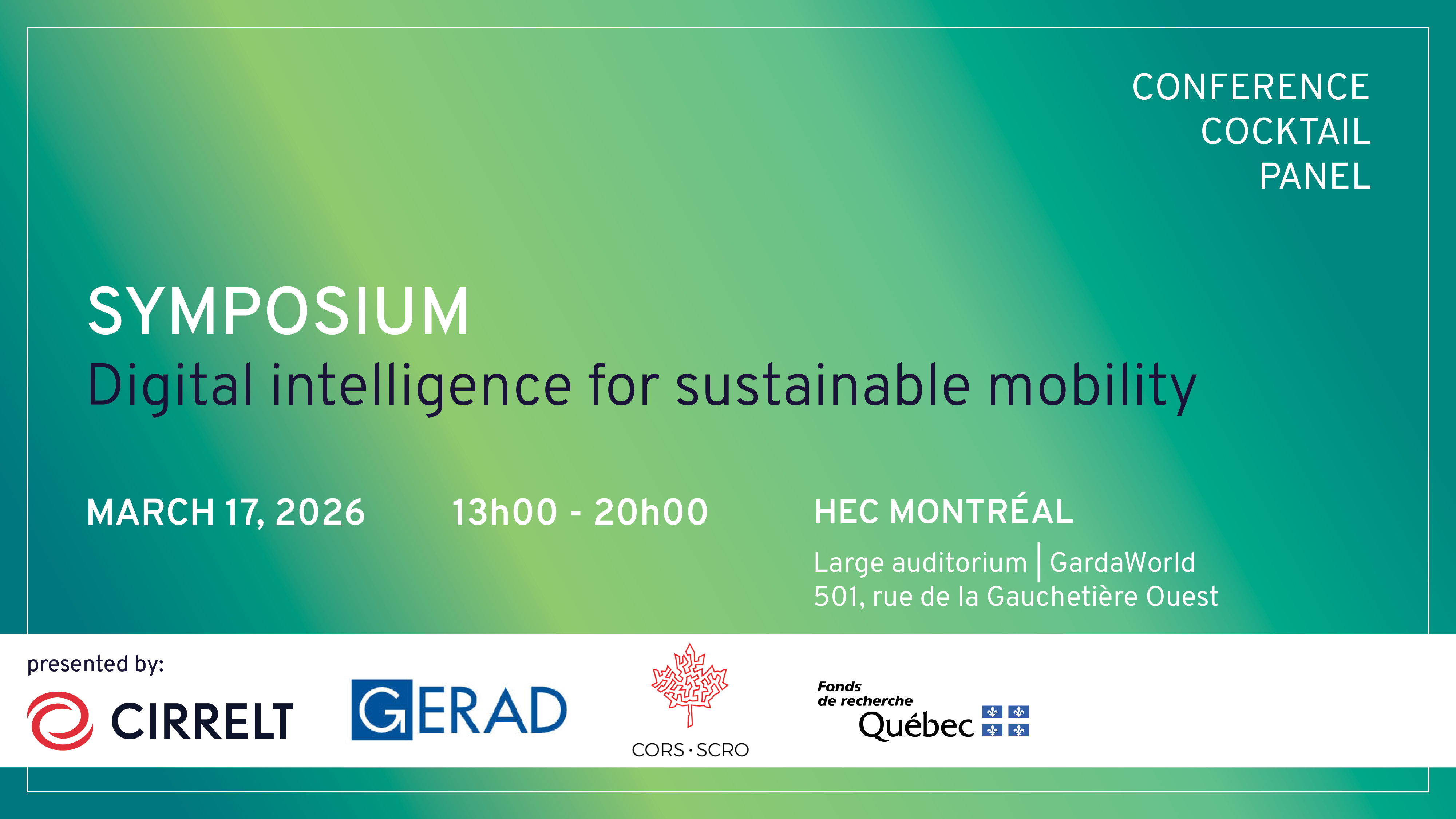
Symposium "Digital intelligence for sustainable mobility"


 share
share
Watch the symposium on YouTube
With more than half of the world’s population already living in urban areas and projections indicating that around 70% of people will reside in cities by 2050, cities face unprecedented challenges in managing mobility and environmental impacts. At the same time, the transportation sector contributes roughly 20% of global CO₂ emissions, underscoring the urgent need to rethink how people and goods move in urban environments.
The Symposium “Digital intelligence at the service of sustainable mobility” brings together researchers, practitioners, and decision-makers to explore how data, optimization, engineering, and digital intelligence can come together to design smarter, cleaner, and more adaptive mobility solutions. Through panel discussions, expert talks, and interactive sessions, the event will address how emerging analytical tools and digital technologies can help decarbonize transportation, improve urban accessibility, and foster sustainable mobility ecosystems.
To access the symposium remotely, please use this link.
Full program
Schedule
- 13h - Opening
13h05 à 14h35 - Part 1
- The Role of Carsharing in Urban Demotorization: Insights from Data-Driven Analysis
Martin Trépanier, Polytechnique Montréal - User-Centric Design of Urban EV Charging Networks
Emma Frejinger, Université de Montréal - Seeing the Invisible: Solving Inverse Problems in Transportation
Lijun Sun, McGill University
- The Role of Carsharing in Urban Demotorization: Insights from Data-Driven Analysis
14h35 à 15h - Coffee break
15h à 16h30 - Part 2
- The environmental impact of shared autonomous vehicles: How to deal with intercity travel?
Francesco Ciari, Polytechnique Montréal - Early-Stage Agentic Transportation Systems (AgTS): Networked AI Agents for Sustainable, Adaptive, and Human-Centered Urban Mobility
Jiangbo Yu, McGill University - Smart Mobility Solutions for the Last Mile
Maryam Darvish, Université Laval
- The environmental impact of shared autonomous vehicles: How to deal with intercity travel?
16h30 à 16h45 - Break
16h45 à 18h30 - Panel
- Anne Mercier, Directrice de l’Innovation – Algorithmes/IA, Giro
- Sam Vermette, PDG, Transit
- Hamzeh Alizadeh, Directeur recherche et valorisation de données, ARTM
- Nicolas Filion, Directeur principal de la technologie, AMD
18h30 à 20h - Cocktail
** Martin Trépanier (Polytechnique Montréal) is co-organizer of the panel.
Location
Campus Hélène-Desmarais
Montréal Québec H2Z 1Z5
Canada
Associated organizations
programme_long_BILINGUE.pdf (300 KB)