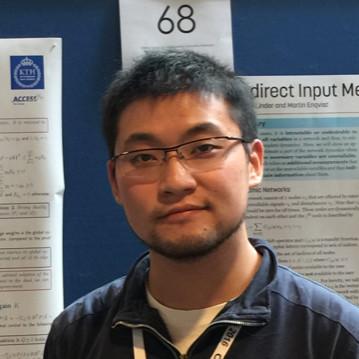
I am an Associate Professor in the School of Automation and Intelligent Sensing at Shanghai Jiao Tong University, where I work with the Autonomous Robot Lab. I studied automation and control there before moving to KTH Royal Institute of Technology, where I received my Ph.D. in Applied and Computational Mathematics in 2019, specializing in Optimization and Systems Theory. After two years in industry, I returned to Shanghai Jiao Tong University in 2021.
My research uses statistics and optimization for system identification, inverse optimal control and robotic decision-making. In inverse optimal control, I infer the objectives behind observed behaviour, with applications to human movement and rehabilitation. Related work includes inverse dynamic games. I am interested in when those objectives can be identified and whether an estimator converges to the correct answer as more data become available. This has led me to develop statistically consistent methods for both linear-quadratic and nonlinear systems.
The same statistical perspective runs through my work on simultaneous localization and mapping (SLAM). For 4D radar, we estimate motion by matching generalized moments of successive point clouds, without requiring individual point correspondences, and incorporate these estimates into pose-graph optimization. I also work on motion planning, where uncertainty in localization and obstacle motion affects collision risk. Our distributionally robust formulations make collision-risk constraints computationally tractable without requiring an exactly known error distribution. This connects statistical models of sensing errors with explicit constraints on the risk accepted by the motion planner. Applications include wheel-legged robots and assistive devices.
I gave a seminar at GERAD in June 2026 and would like to continue those discussions with colleagues in optimal control, game theory and optimization under uncertainty. A question I hope to pursue together is how to carry uncertainty in inferred objectives and estimated states into planning and feedback control, while keeping computations feasible in real time. GERAD would also give me the chance to learn how researchers in other application areas approach related inference and optimization problems. I look forward to joint projects and exchanges involving students, and to bringing problems from our robotic systems into these collaborations.



 share